Information Systems
Mailing Address
Cleveland State University
Monte Ahuja College of Business
2121 Euclid Avenue, BU 344
Cleveland, OH 44115-2214
information_systems@csuohio.edu
Campus Location
Monte Ahuja Hall, Room 344
1860 E. 18th Street
Cleveland, OH 44114
Phone: 216-687-4760
information_systems@csuohio.edu

Department Instagram £
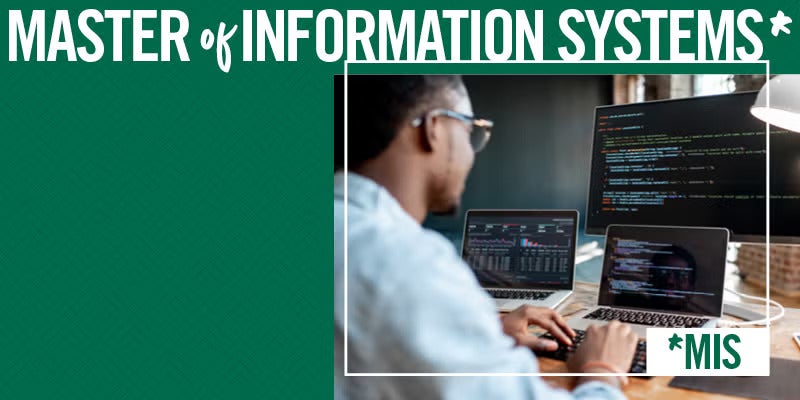
A specialized STEM program, Cleveland State University’s Master of Information Systems (MIS) prepares students to excel in today’s dynamic, technology‑driven business environment. Available in an online format, the program is designed for both working professionals and career‑changers—no prior IT background is required.
Students develop the ability to excel in the evolving field of information technology, applying management expertise to support business operations, drive data‑informed decision‑making, and contribute to strategic planning as information systems experts. Program concentrations allow students to customize their learning and build in‑demand skill sets in areas such as information security, information technology management, and business analytics.



Why Choose Cleveland State for your Master's in Information Systems?
In a time when information is paramount, the MIS degree at Cleveland State University stands out as a prime choice for those looking to make a significant impact in the world of information systems. Here's why students choose our program:
- Flexible online option: Complete the MIS degree fully online, allowing you to advance your education while balancing professional and personal commitments.
- Designed for diverse backgrounds: Students do not need an undergraduate degree in IT. The program welcomes applicants from a wide range of academic and professional backgrounds and provides preparatory coursework to ensure success.
- Focused on innovation and business impact: Housed within the Monte Ahuja College of Business, the curriculum blends of technology and management-oriented coursework, preparing graduates to lead organizations, improve busies processes, and leverage information systems for a strategic advantage.
- Three customizable sub-tracks: Students may pursue one of three paths - the thesis, the non-thesis or internship sub-tracks - allowing them to tailor the program to their career goals, whether in industry, analytics, or further academic study.
- Rolling admissions: Applications are accepted year-round. Domestic applicants must submit a completed application at least six weeks prior to the start of the semester they intend to enroll.
- Preparatory support for non-IT majors: Students without an information systems background are encouraged to complete preparatory course with a great of "B" or better before entering the program, ensuring confidence and readiness in core technical concepts.
- Expert, engaged, faculty: Faculty bring extensive research and industry experience, working closely with students on projects in areas such as database design, artifical intelligence, analytics, cybersecurity, simulations and emerging computing technologies.
Our MIS program curriculum provides a robust education in information system management and develops your specialization with three concentration options. Through a structured and customized academic journey, you graduate ready to transform business operations with innovative technical solutions.
The program consists of a total of either 31 or 33 credits, and you engage in 18 credits of mandatory core courses. These include:
- Project management and scheduling
- Emerging technologies
- Systems thinking and modeling for dynamic information systems
- Advanced analysis and design
- Enterprise databases
- Managing network security and risk
Required electives (13 or 15 credit hours) round out your education and allow you to customize your studies to subjects that interest you. Electives include:
| Course | Name | |
|---|---|---|
| IST 610 | Object-Oriented Programming for Information Systems | |
| IST 612 | Business Analysis | |
| IST 615 | Business Intelligence Systems | |
| IST 620 | Legal Environment of Information Systems | |
| IST 635 | Business Value of Information Technology | |
| IST 636 | Managing Networks and Security Risks | |
| IST 641 | Electronic Commerce | |
| IST 656 | Advanced Information Security | |
| IST 660 | Data Mining and Business Intelligence | |
| IST 664 | Business Geographics and GIS | |
| IST 665 | Enterprise Resource Planning | |
| IST 675 | IT Governance | |
| IST 680 | Social and Information Network Analysis | |
| IST 699 | Thesis Research in Computer and Information Science | |
Ideal for those looking to advance their career in IT, students in this concentration take courses in business analysis, the business value of IT, enterprise resource planning and IT governance. This path requires one additional elective outside of the concentration.
Those with an entrepreneurial disposition and acumen for business strategy find this concentration prepares them to contend in advanced management careers. Students take introduction to business analytics, applied business analytics, managing databases and strategy for business analytics. While in the concentration, students also earn the Certificate in Business Analytics.
Interested in a profession maintaining and stewarding data security and privacy? Students prepare for this in-demand field in the security concentration with courses in information security, advanced information security and information systems auditing. Two additional electives outside the concentration complete this pathway.
Cleveland State University's Master of Information Systems program prepares students for rewarding careers in information systems and technology management. With a structured, hands-on education, our students graduate well-equipped to grapple with the complexities of the business world and transform the industry.
Graduates from our MIS program often attain roles within:
- Information technology consulting firms
- Cybersecurity organizations
- Data analytics companies
- Healthcare information systems management
- Business intelligence and data management
- IT strategy and management
- Public and private sector organizations
Learn More About Cleveland State's Master of Information Systems
Cleveland State University's MIS degree program provides a comprehensive education in information systems, setting you up for preparing you for success in today's rapidly evolving, technology-driven business landscape. Students graduate with the knowledge and skills to bridge technology and strategy, manage complex information systems and drive positive change across organizations.
The MIS program is available fully online, offering the flexibility to advance your career while balancing profession and personal commitments. Explore the online MIS option.
To support aspiring professionals, CSU offers a scholarship for domestic students admitted to the Master of Information Systems program, making it even more accessible to invest in your graduate education. Discover more.
Learn more about the information systems master's degree by requesting information or contacting a program staff member directly.
Course Details
[4 credit(s)]
Prerequisite: Must be admitted as a graduate student to be eligible for this course. This is an introduction to computer programming for Business and Information Science students. No previous experience and knowledge of programming is required. Visual Basic .Net is used to teach solid programming concepts and practices. The course is divided into two parts: (a) An introduction to foundations in programming, and (b) Advanced development of business solutions using the OOP approach. The first part of the course teaches the elementary building blocks of programming; variables, arrays, user-defined types, flow-control, and decision making. The goal of the second of this course is to provide students with a comprehensive understanding of object-oriented system development. Though the main focus of the course is on the VB. NET programming language and its use in OO system development, it also provides in-depth introductions to ASP.NET and HTML programming languages.
[3 credit(s)]
Provides an understanding and appreciation for the role of information technology and how this technology is leading changes in an organization. Discusses the competitive role of IT and how it affects the strategy and operation of modern business organizations nationally and internationally. Enables students to lead technology-enabled organizational change involving collaboration technologies.
[3 credit(s)]
Prerequisite: IST 211. Introduction to the tools and techniques of systems analysis including requirements determination, use case analysis, process modeling. Object-oriented analysis and design will be incorporated through the use of the Unified Modeling Language and the Rational Unified Process.
[3 credit(s)]
Prerequisite: IST 211. This course introduces database concepts. It focuses on the construction, management, and utilization of relational databases. The student is exposed to an extensive coverage of SQL (Structured Query Language) for basic and advanced queries. Examples of enterprise-level production systems are used for stand-alone and embedded SQL-based applications.
[3 credit(s)]
Prerequisite: IST 211. Basic knowledge of data communications and networking requirements, including appropriate technologies. Emphasis on analysis and design of networking applications in organizations. Management of telecommunications networks, cost-benefits analysis, and evaluation of connectivity options are also covered. Students learn to evaluate, select, and implement different communications options within an organization. Contents: telecommunication devices, media systems, network hardware and software: network configurations; topologies and protocols; installation and operations of bridges, routers and gateways; network administration; performance analysis; privacy, security, reliability; Installation and configuration of LAN and WAN; Internet and intranet.
[3 credit(s)]
Graduate students in other programs are permitted to take the course, MIS students should complete the preparatory programs before taking the course. This course is designed to teach the students the nature and scope of Project Management (PM). The students will learn the planning process of a project as well as managerial challenges associated with the design, control and scheduling of projects. The course discusses techniques and decision tools used in solving project management issues as well as strategies for successfully managing Information Technology Projects. Project management software will be used throughout the course.
[3 credit(s)]
Prerequisite: Completion of the MIS preparatory program or permission from the department. Introduction to current research topics in information systems. Explores how research is done in the areas. State-of-the-art industrial practices are also examined. Students make presentations on current research topics in information systems based on surveys of recent conference and journal articles. Must be taken the first semester after completion of the preparatory program.
[3 credit(s)]
Prerequisites: Completion of the MIS preparatory program or permission from the department. This course in systems thinking assesses IS/IT systems by examining the entire system, including human, community, resource, environmental, and social processes, to get a holistic view into how organizations and individuals often look at the world, assess problems, and invent solutions. Because the way systems are designed determines outcomes, the course also looks at system dynamics and the intended and unintended consequences of various actions. Using nonlinear thinking to complement typical linear way of thinking, students will learn, step by step, the standard methods of system dynamics governed by levels/rates or stocks/flows processes. They will conceptualize and build a system dynamics model, from scratch, conduct appropriate model analysis, and develop model-based recommendations. Based on hands-on experience in computer simulation and gaming, students will learn to perform model formulation and validation in diverse settings.
[3 credit(s)]
Prerequisite: IST 603 or equivalent. Introduces advanced systems principles and concepts; logical analysis, design and modeling of software systems with emphasis on object oriented systems; use of Unified Modeling Language, the Rational Unified Process, and CRC cards; use of CASE tools, with emphasis on use cases and use case diagrams, class diagrams, sequence diagrams, collaboration diagrams, and state diagrams.
[3 credit(s)]
Prerequisite: IST 604 or equivalent. Detailed study of modern relational database systems and non-relational database systems for Enterprise Business Analytics. First, the course studies core components of relational database systems with the query processing concept and execution techniques, query optimization strategies of modern relational databases. Then the course advances with the study of semi-structured databases and non-structured data processing. The course continues with the study of the advanced features of modern Business Intelligence systems with Parallel Data Warehouse (PDW) and data mining algorithms. Finally, the course will explore current database industry research papers on big data processing and cloud computing.
[3 credit(s)]
Prerequisite: IST 506 or equivalent. Advanced knowledge of data communications and networking as they apply to computer security. Identifying and analyzing the various types of security risks. Investigating the tools used to counteract security risks. Developing security and business continuity plans based on the security risks and tools incorporated.
[3 credit(s)]
Prerequisite: IST 211 or equivalent. The concept of object-oriented methodologies and programming are presented through Java and/or the C++ programming languages. Language syntax, error handling, object creation/destruction, and memory allocation strategies are explored. Java GUI components, event handling, and web-based programming are introduced.
[3 credit(s)]
Business analysis involves identifying business needs and determining system solutions to business problems. Typically, the solutions include a systems development component but may also consist of process improvement, strategic planning and policy development. Major areas of study include: Enterprise Analysis, Requirements Planning and Management. Requirements Elicitation, Requirements Analysis and Documentation, Solution Assessment and Validation. This course aims to (i) introduce advanced concepts related to business analysis, (ii) help students gain in depth knowledge of various techniques used in business analysis, (iii) develop skills required to complete various business analysis tasks, (iv) illustrate various business analysis practices employed in the industry (v) understand the role of change management and communication in business analysis. This course does not require any technical expertise and will not teach any specific computer programming.
[3 credit(s)]
Graduate students in other programs are permitted to take this course, MIS students should complete the preparatory programs before taking the course. Study of areas in which computers can be used as tools in management decision making and evaluation of alternatives. Functional components of a Decision Support System (DSS). Decision models and end-user modeling. User-DSS interfaces. Planning and developing a DSS. Concepts of knowledge-based systems and expert systems. Components of expert systems. Knowledge acquisition. Expert-systems development with a commercial shell. Manipulation of quantified uncertainty factors. Derivation of knowledge from data. Significance of groupware and document-management systems to decision making.
[3 credit(s)]
This course provides students with a deep understanding of cryptocurrency and its underlying blockchain technology. Will touch on blockchain applications. Introduces blockchain implications in business, current challenges, law and licensing, and the latest progress in the field.
[3 credit(s)]
Must be admitted as a graduate student to be eligible for this course. This subject will expose students to models and methods for aligning a business strategy with appropriate investment in information technology infrastructure and services. A variety of information and technical architectures will be explored together with how they relate to different styles of business strategy. In particular, the focus will include architectures that will enable flexible collaboration with business partners so that the business value can be realized from the firm’s IT investment.
[3 credit(s)]
Prerequisite: IST 506 or equivalent. Cloud computing is the delivery of computing services (including servers, storage, databases and networking) over the Internet in order to achieve greater flexibility, faster innovation and economies of scale. Cloud computing services are being widely adopted in organizations in a variety of domains in order to maintain flexibility and gain a competitive advantage. Students in this class will gain an overview of the field of Cloud Computing, its enabling technologies and major components through hands-on tutorials and projects using public cloud infrastructure as well as an understanding of how cloud computing can be used to advance the goals of the organization.
[3 credit(s)]
Prerequisites: IST 600 and IST 601. Provides an understanding of evolving Internet technologies and explores the business implications of these developments. Focus is on the fit between technology and strategy. Provides tools, skills, and an understanding of technology, business concepts, and issues that surround the emergence of electronic commerce on the Internet. In addition to acquiring basic skills for navigating the Internet and creating a personal electronic presence on the World Wide Web, the student develops an understanding of the current practices and opportunities in electronic publishing, electronic shopping, electronic distribution, and electronic collaboration.
[3 credit(s)]
Prerequisites: IST 636/736 or CIS 675. Covers advanced topics in information including disaster recovery and business continuity plans, digital forensics, and mobile device security.
[3 credit(s)]
Prerequisite: Completion of the MIS preparatory program or permission from the department. This course introduces the basic concepts of business analytics, data warehousing, and data mining. Topics discussed include: the need for business analytics in today’s dynamic business environments, data warehousing strategies, technologies, designs, and architectures (e.g., star schemas), data mining techniques and algorithms (e.g., clustering, classification, predictive modeling, decision trees, neural networks, and visualization). Sample applications of these technologies and techniques will be discussed. Textbook will be supplemented with current articles on data mining technology and applications.
[3 credit(s)]
Prerequisite: None. This course introduces data science analytics tools and techniques for geographic data (e.g., maps, geosensors, satellite and GPS location data). A comprehensive coverage of the issues with handling space-time data from the perspective of DBMS, GIS, Data Analytics, and Big Data Systems. Students will learn spatial database concepts, algorithm, statistical tools to model and analyze problems by hands-on approach using programming languages. Cover spatial and temporal data representation, exploratory analysis, and prediction models. Also, introduces software to perform geographic query, analysis, visualization and custom application development for decision support. Emphasizes issues related to spatial data mining, integration of machine learning techniques in spatio-temporal analysis and prediction.
[3 credit(s)]
Prerequisite: IST 504 or equivalent. This course addresses the increasing need to integrate a broad range of enterprise processes, information systems functions, and hardware and software technologies. Topics covered include: the need, motivation, and business drivers for integration-in any of its forms: processes, functions, or technologies; challenges and obstacles related to integration and implementation of comprehensive enterprise systems within and across organizations; planning, initiating, selecting, realizing, supporting, and maintaining an enterprise system. Change management issues and team dynamics relating to enterprise systems will also be discussed. The course will also touch on specific integration models and technologies.
[3 credit(s)]
Prerequisites: Completion of the MIS preparatory program or permission from the department. IT Governance is a collection of processes that define the management, planning, review, and performance reporting that establishes control over IT investment, projects, and delivery of services. IT Governance “helps ensure that IT supports business goals, optimizes business investment in IT, and appropriately manages IT-related risks and opportunities” (COBIT). This includes creating appropriate decision rights and accountability frameworks. This course explores these processes to better understand how organizations can achieve higher levels of IT effectiveness by developing their governance processes. Material covered includes best practices from existing industry standards such as COBIT, ITIL, and ISO.
[3 credit(s)]
Prerequisite: IST 636. The course examines the interconnectedness of modern life through an exploration of fundamental questions about how our social, economic, and technological worlds are connected. Students explore game theory, the structure of the Internet, social contagion, the spread of social power and popularity, network models of markets, online auctions, and information cascades.
To see a complete list of classes required, visit the CSU Catalog
Mailing Address
Cleveland State University
Monte Ahuja College of Business
2121 Euclid Avenue, BU 344
Cleveland, OH 44115-2214
information_systems@csuohio.edu
Campus Location
Monte Ahuja Hall, Room 344
1860 E. 18th Street
Cleveland, OH 44114
Phone: 216-687-4760
information_systems@csuohio.edu
Department Instagram £